

I'll say the annoying part first instead of burying it at the bottom: this machine does not stop drum bass. I found that out the hard way three weeks after buying it, on a call with a bookkeeping client while my upstairs neighbor's twelve-year-old, Tyler, was working through what I can only assume was a marching band audition piece. The Magicteam white noise machine I'd bought the month before, the one every five-star Amazon review promised would fix exactly this, did nothing for the low thud coming through my ceiling. It handled his footsteps fine. It did not touch the kick drum.
That's the honest starting point for this review. I've had the Magicteam Sound White Noise Machine running in my apartment home office for a little over three months now, through two different desk setups and one very loud stretch when the building's shared driveway got repaved. I'm not going to tell you it's magic. I'm going to tell you exactly what it fixed, what it didn't, and the small stuff nobody mentions until you've actually lived with the thing for a few weeks.
The Quick Verdict
Excellent at masking mid and high-frequency noise like voices, footsteps, and appliance hum. Genuinely weak against low bass rumble like drums or bass-heavy music through a wall. Worth it if you know what you're buying.
Amazon Check Today's Price →Before You Buy Based On the Five-Star Reviews Alone
Most reviews of this thing read like ads. This one tells you what it actually blocks and what it doesn't, so you're not surprised three weeks in like I was. It's still one of the cheapest fixes on the market for the noise it does handle.
Amazon Check Today's Price on Amazon →How I Actually Tested It
I work from the second bedroom of a two-bedroom apartment I split with my roommate Meg, who runs the overnight shift as a lab tech at a hospital about twenty minutes away. That means she's asleep during my entire workday, which is its own noise problem, and I'm often on client calls during her sleeping hours trying not to be the reason she's up at 1pm. My desk sits under a window that faces the shared driveway, and the building's window-unit HVAC hums outside it from May through September. I didn't need a device to make my house quiet. I needed one to keep the noise that was already there from reaching a client's ears on a video call.
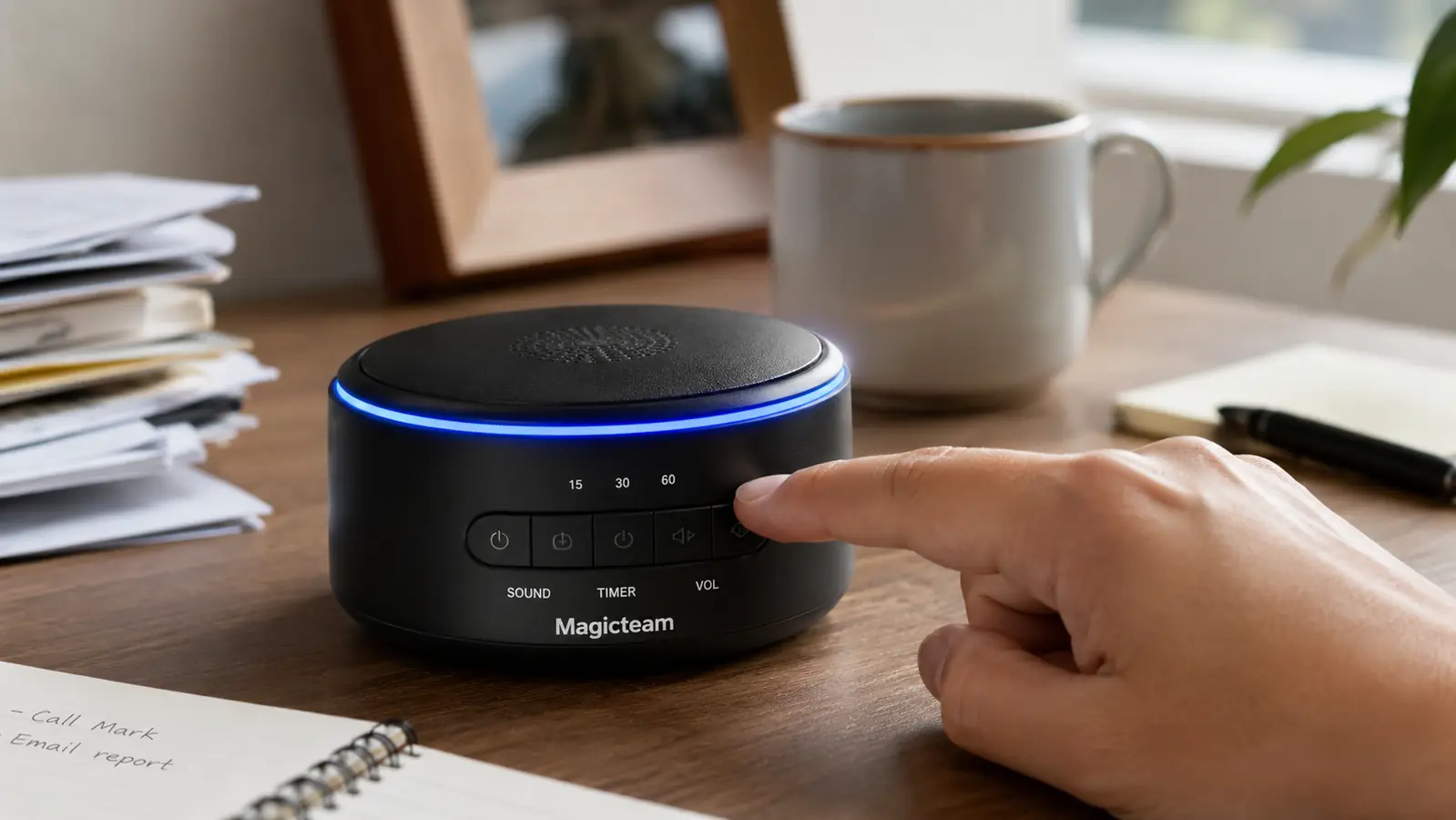
For the first month I ran the machine every single workday, tracking what actually got masked and what didn't by paying attention to what I could still hear with headphones off, since that's roughly what my laptop mic would also pick up. I moved it between three spots, the corner of my desk, the windowsill directly behind my monitor, and briefly a bookshelf across the room, to see if placement changed the results. It did, more than I expected going in.
I also ran it side by side with a free white noise app on my phone for about a week, just to see if the machine was actually earning its keep over something free. That comparison is where a lot of this review's honest opinions came from, because the differences were smaller in some areas and bigger in others than I assumed they'd be.
The Things Nobody Mentions in Their Five-Star Review
First, the plastic housing has a faint chemical smell out of the box that took about four or five days of running to fully fade. It's not toxic-smelling or alarming, more like new-electronics smell, but if you're sensitive to that kind of thing, know it's there for the first week and don't panic about it.
Second, at certain volume levels, specifically between about level 22 and 26 out of the 32 available, my unit has a very faint electronic hum underneath the actual white noise track. It's subtle enough that I only noticed it once I was actively listening for flaws rather than working, and it disappears entirely below level 20, which is where I run it most days anyway. Still, it's the kind of thing a glowing review skips over because most people never crank it up that high long enough to notice.
Third, the memory function that saves your last sound and volume does not survive a full power outage, only a manual unplug and replug. During the driveway repaving, our building had two short power blips, and both times the machine reset to its default sound and a mid-range volume rather than picking up where I'd left it. It's a small distinction, manual unplug versus power failure, but if you're counting on the memory feature to always hold your settings, it has a gap worth knowing about.
Fourth, if you plug it into a power strip or surge protector rather than directly into the wall, I noticed a very slight buzz on two different strips I tried, both mid-range brands, not the bargain kind. Plugging directly into the wall outlet cleared it up both times. I don't have an engineering explanation for why, but it was consistent enough across two strips that I think it's worth mentioning rather than assuming it was a fluke.
Where It Genuinely Falls Short on Bass and Voices
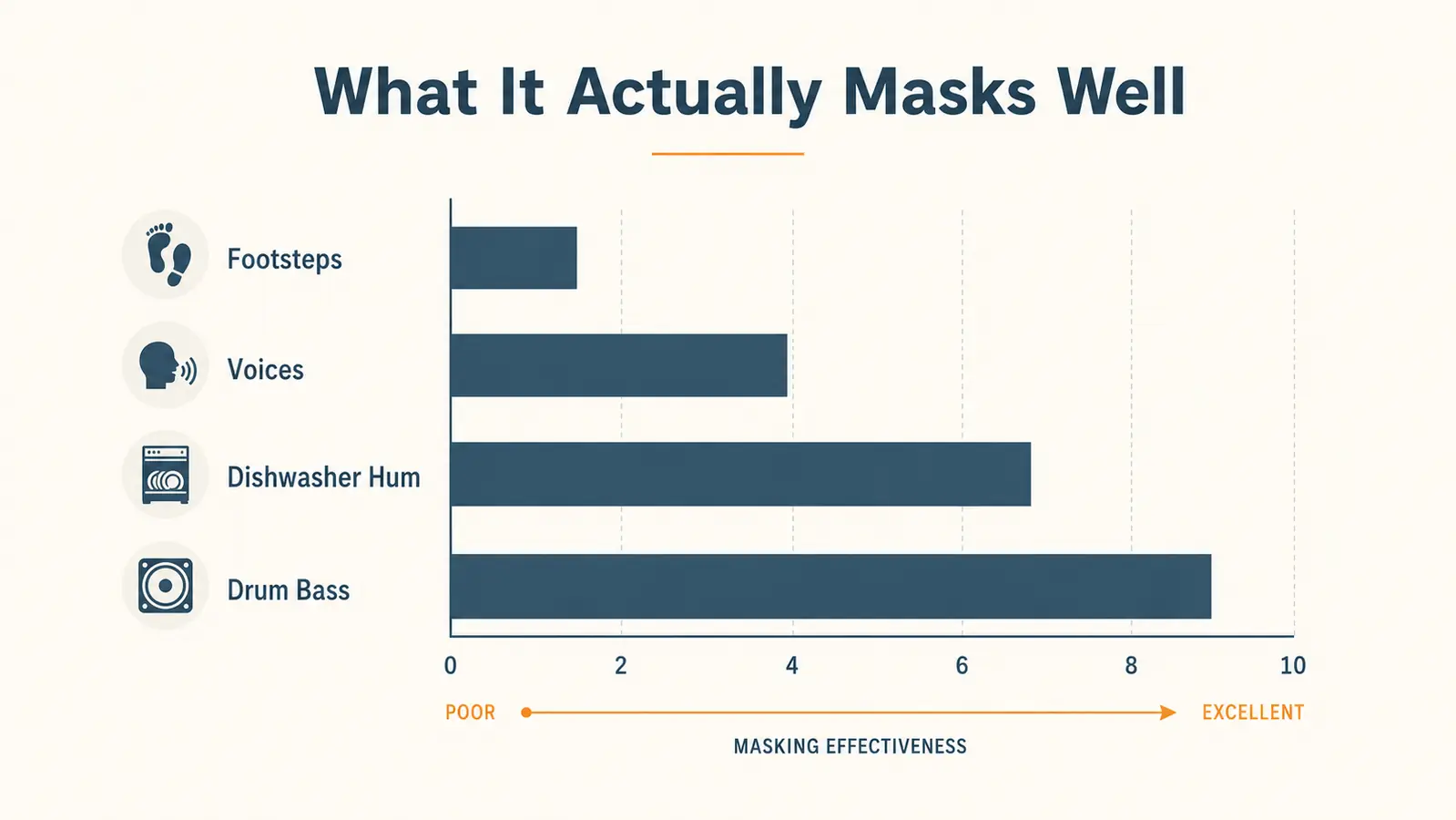
The drumming situation I mentioned up top wasn't a one-off. Over three months I've paid close attention to which noises this machine handles and which ones slip right through, and there's a clear pattern. Footsteps, a door closing, the dishwasher's hum, the HVAC unit outside my window, all of that gets smoothed over well by the white noise setting, even at a fairly modest volume around level 16. Those are mid to high-frequency sounds, and that's exactly where this kind of masking device does its best work.
Low bass is a different story. Tyler's drum practice, a car with a subwoofer idling outside, or Meg occasionally running a bass-heavy podcast before bed all pass through with barely any reduction, because low frequencies carry through walls and floors in a way a small single-speaker machine simply isn't built to counter. If your actual noise problem is bass-heavy, thumping music, a subwoofer, drums, this machine will disappoint you no matter how high you turn it, and turning it up just adds its own noise on top without solving the low end.
Voices are somewhere in the middle, and this is where I'll push back a little on the more skeptical reviews I read before buying. A single person talking normally in the next room does get meaningfully quieter and less intelligible with the machine running at a decent volume. What it can't do is fully erase a loud, animated conversation or a TV playing dialogue at normal volume through a shared wall. It reduces the clarity and the ability to make out words. It does not make voices disappear.
The Sleep Timer and Memory Function: The Fine Print
Meg uses the sleep timer more than I do, setting it for roughly the length of her wind-down before an overnight shift so it shuts off on its own instead of running all day in an empty room. I tested the timer against my phone's clock across six separate uses and it was accurate within a minute every time, which is close enough for anything short of a lab setting.
The volume dial itself has no printed numbers, only felt notches, which I found more annoying than I expected. After moving the unit between the windowsill and the desk a few times over three months, getting back to my exact preferred level takes a bit of guesswork by ear rather than lining up to a visible marker. It's a small design choice that would have cost almost nothing to fix and would have made a real difference in day-to-day convenience.
What Three Months of Daily Use Has Done to the Unit
I plug and unplug this thing constantly, moving it from the desk to the windowsill and occasionally to the bathroom for Meg when she wants sound running while she showers before her shift. That's more physical handling than most desk gadgets get in a year, and after three months the button row still has a firm, consistent click with no mushiness, and the housing itself hasn't developed any creaks or loose panels despite being picked up and set down probably four or five times a day.
The AC adapter cord has held up fine, but I did notice the fabric-wrapped section near the plug end starting to fray slightly where it bends most often, right at the point where it exits the wall outlet behind my desk. It's cosmetic at this point, not a functional issue, but it's the kind of early wear sign I'd want to know about if I were buying this expecting years of daily travel between rooms rather than sitting in one fixed spot.
Dust collects in the speaker grille the same way it does on any desk object left running for months, and I've had to brush it out twice already, more often than the long-term reviews I read before buying suggested. Between the dust and the fraying cord end, none of it has affected performance, but if you're the type who likes gear to look pristine after a few months, keep a small brush handy.
How It Compares to What I Tried Before
The free white noise app on my phone that I ran side by side with this machine for about a week held up surprisingly well on pure sound quality, since it's streaming actual recorded audio rather than generating it locally. Where it fell apart was reliability. My phone would ring, a text notification would chime over the top of the white noise, or I'd forget and lock the screen, cutting the sound entirely mid-call. The Magicteam machine has one job and does it without competing for my phone's attention, which ended up mattering more than the marginal audio quality difference.
I also briefly considered a small desktop fan as a cheap masking option, since a former coworker swore by hers. A fan does move air and does generate a steady low hum, but it doesn't have the volume range or the variety of sound options this machine has, and it can't be dialed down to a whisper for late-night use the way this can. For roughly the same price as a box fan, the Magicteam machine gives you far more control over what you're actually trying to mask.
Foam earplugs were the third thing I tried, mostly during Meg's daytime sleep hours before I owned this machine. They work, technically, but wearing them during my own work calls isn't an option since I need to hear myself and my clients clearly. Earplugs solve the problem for the person trying to sleep, not the person trying to work through a video call, which is really the gap this machine ended up filling for both of us at the same time.
What I Liked
- Genuinely effective at masking mid and high-frequency noise, footsteps, voices, appliance hum
- 20 non-looping sound options give you real variety beyond plain white noise
- Sleep timer tested accurate within a minute across repeated use
- Runs quietly on lower volume levels with no audible hum or distortion
- Button and dial mechanisms held up firm and consistent through three months of frequent handling
- Cheap enough that the risk of trying it is genuinely low
Where It Falls Short
- Does almost nothing against low bass frequencies like drums or bass-heavy music
- Faint electronic hum appears at higher volume levels, roughly 22 through 26
- Memory function doesn't survive a full power outage, only a manual unplug
- Slight buzz noticed on two different power strips, cleared up plugged directly into the wall
- Fabric-wrapped cord near the plug end shows early fraying from frequent moves between rooms
- No printed markings on the volume dial makes returning to your preferred level a guessing game
It didn't fix my noise problem. It fixed most of it, and it was honest enough about the rest that I stopped expecting it to.
Who This Is For
If your home office noise problem is footsteps, voices, appliance hum, or a mismatched sleep schedule with a roommate or partner, this machine handles exactly that kind of noise well and costs less than a delivery lunch. It's a solid, low-risk buy for apartment living, shared houses, or any setup where the noise coming in is more mid-range than bass-heavy.
Who Should Skip It
If your actual problem is bass, a downstairs neighbor's subwoofer, a kid's drum kit, a car stereo idling outside, don't expect this machine to solve it, because I tested that specific scenario for three months and it simply doesn't reach low frequencies. You'd need a different approach entirely, likely something addressing the structure itself rather than masking sound in the room. And if you need precise, repeatable volume settings without any guesswork, the unmarked dial will bother you more than it bothered me.
Know Exactly What You're Getting Before You Click Buy
This isn't a miracle fix for every kind of noise, but for the footsteps, voices, and hums that actually interrupt most calls, it earns its spot on the desk for less than the cost of a takeout order.
Amazon Check Today's Price on Amazon →