
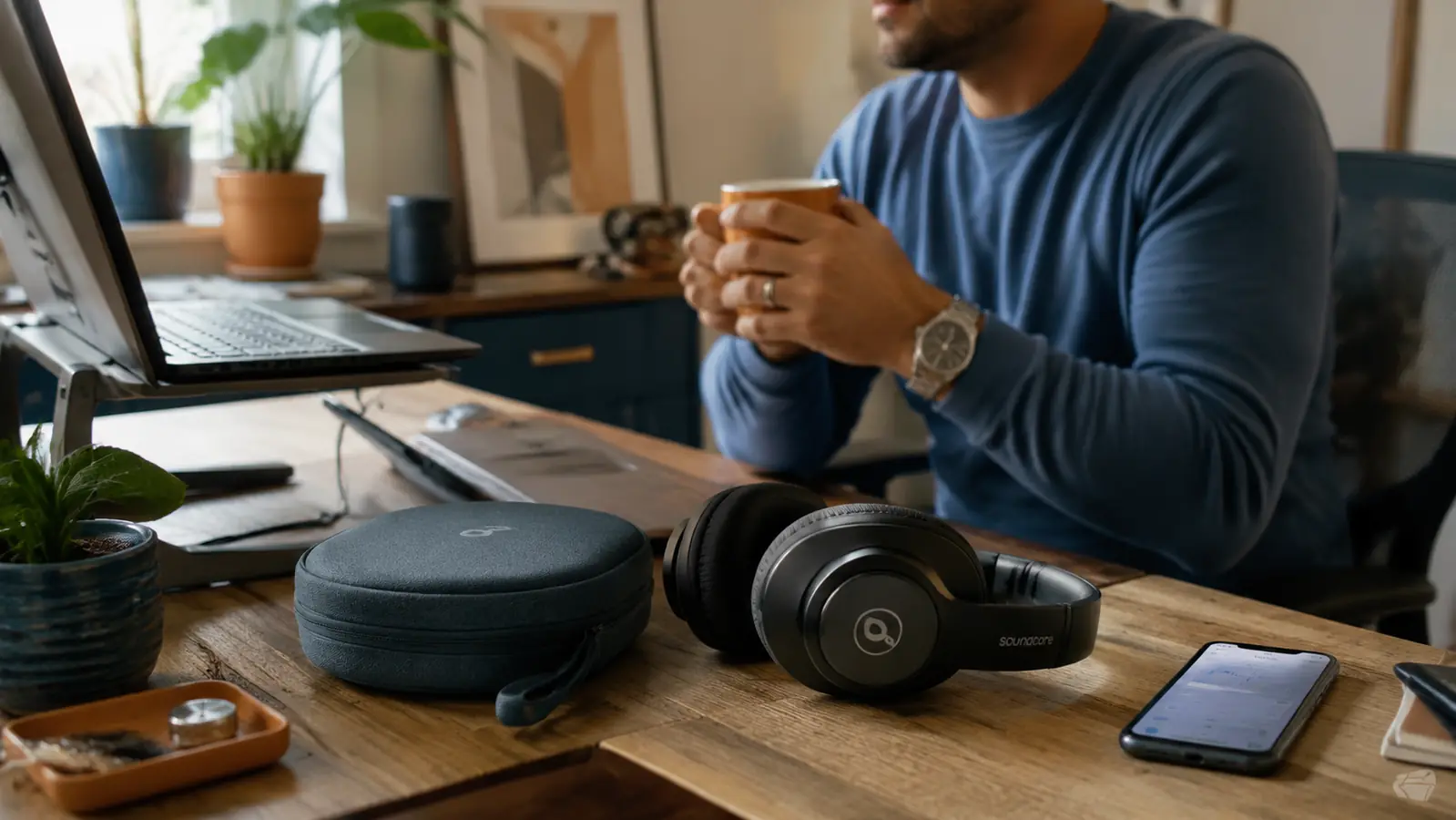
Before I bought the Soundcore Q30, I did what most people do and read four or five long-term review style articles online. Every one of them read like a paid testimonial. No real complaints, no returns, no regrets, just a steady stream of praise. I bought a pair anyway because the price was hard to argue with, and I told myself I'd write down every annoyance the moment I hit it instead of waiting months and smoothing it over in hindsight. Four months later, I still have that running list. This is the honest version, not the highlight reel.
I work as a freelance copywriter out of a one-bedroom apartment two floors above a convenience store, with a bus stop directly under my window and a boutique gym next door that runs bass-heavy playlists through the shared wall most mornings. That's a different kind of loud than a quiet suburban office, constant, low frequency, and mechanical instead of occasional and sharp. I bought the Q30 specifically to see if a headphone priced in the budget range could hold up against that, not against some hypothetical quiet office nobody actually has.
The Quick Verdict
Real noise cancelling for the price, but the touch controls, the flimsy case, and the weak transparency mode are the parts the glowing reviews conveniently skip.
Amazon Check Today's Price →Nobody mentions the touch panel until you own one
I'll walk you through the annoying parts most reviews leave out, and exactly why I still haven't returned mine after four months. Check today's price and decide for yourself.
Amazon Check Today's Price on Amazon →How I Tested It, and What I Almost Returned It For
I gave myself a strict thirty-day return window and used that deadline as pressure to actually stress test the Q30 instead of just wearing them around the apartment. I wore them on client calls, on the twelve-minute walk to a coworking space I rent by the day, on a red-eye flight to visit family, and during long writing blocks with music instead of silence. I logged what bothered me every single time, even small things, because those are exactly the details a review written after the fact tends to quietly forget.
The first 48 hours nearly ended the relationship. The touch panel on the right ear cup controls play, pause, volume, and calls, and it is sensitive enough that adjusting my glasses or scratching an itch near my ear paused whatever I was listening to at least four separate times in the first two days. I looked up the return policy twice before I'd even owned them a full week.
What kept me from sending them back was realizing the touch sensitivity problem is a learning curve, not a defect. Once I mapped out exactly where the panel's active zone sits, roughly the back third of the right ear cup, the accidental pauses dropped to about once a week. Nobody puts that in the box, and most reviews skip it entirely because by the time they're writing the review, they've already learned it without noticing. You have to figure it out the hard way, which is exactly why I'm spelling it out here.
The moment I decided to actually keep them came on a Thursday client call in my second week. I'd forgotten to switch off the ANC's Indoor mode before stepping outside to grab a package, and the gym's playlist that normally bleeds through my wall was almost entirely gone, replaced by the ordinary sounds of the hallway. My client asked where I'd moved my office to. I hadn't moved anywhere. That was the first moment the Q30 felt like it was actually doing its job instead of just advertising that it could.

The Touch Controls Are the Part Every Glowing Review Skips
I've used headphones with physical buttons before, and I underestimated how much I'd miss them until I didn't have any. A physical button gives you a click you can feel through gloves or in the dark. The Q30's flat touch surface gives you nothing until it's already registered the tap, which means every accidental brush against your ear, your hair, or your glasses arm counts as an input whether you meant it or not.
There's no setting in the Soundcore app to reduce touch sensitivity, which is the gap I'd fix first if Anker asked me. The app lets you remap what a double tap or triple tap does, but it can't make the panel less trigger-happy. My workaround now is a habit, not a fix, I keep my hand away from the back of my right ear entirely and use the app on my phone for anything beyond a basic play or pause. It works, but it's an extra step nobody mentions until you're the one dealing with it.
The worst version of this happened during a client call in month two, when I reached up to push my hair back and accidentally answered an incoming second call, dropping my client mid-sentence into a three-way mess I had to apologize my way out of. That's the kind of story that never makes it into a five-star review because it's embarrassing, but it's exactly the kind of thing you should know is possible before you're the one explaining it to a client.
Transparency Mode Sounds Better in the Marketing Photos Than in Your Ear
One feature that gets glossed over in most write-ups is the Q30's transparency, or ambient sound, mode. On paper it's meant to let outside sound in so you can hear a delivery knock or answer someone without pulling the headphones off. In practice, voices come through with a slightly hollow, tunnel-like quality, like the person is talking into a cardboard tube rather than standing in the room with you.
It's usable, and it's a genuine convenience over yanking the headphones off every time someone talks to me, but it's noticeably behind what I've heard from pricier ANC headphones in a store demo. Outdoors, it gets worse. Any bit of wind across the mic housing turns into a rough scratching sound in transparency mode, which is the reason I stopped using it on my walks to the coworking space and just switch to Indoor ANC mode or take the headphones off entirely when I need to hear traffic clearly.
I also tested transparency mode specifically for hearing my own name called out, since that's the actual real-world use case most people buy it for. At the convenience store downstairs, a cashier had to repeat herself twice before I registered she was talking to me, even with transparency mode active. It's not that the mode does nothing, it clearly lets sound through, it's that the tunnel-like quality makes voices blend into background noise instead of standing out from it the way a tap on the shoulder would.
The Wired 'Hi-Res Audio' Feature You'll Probably Never Use
The Q30's packaging leans hard on Hi-Res Audio certification, and it's technically true, but only over the included 3.5mm wired cable, not over Bluetooth. I plugged in and tested this exactly once, sitting at my desk connected to my laptop's headphone jack, and yes, the detail improved slightly on a few high-fidelity test tracks. I haven't touched the cable since. Almost nobody buying a wireless ANC headphone for work calls is going to dig out a cable and give up the wireless convenience for a marginal audio bump.
Over Bluetooth, which is how I actually use these every single day, the Q30 does not support aptX or LDAC, the higher-bandwidth codecs some competing headphones use. On an iPhone this barely matters since Apple doesn't support those codecs anyway, but it's worth knowing the Hi-Res Audio badge on the box describes a mode you'll likely never use in real life, not the wireless experience you're actually paying for.
The Case Situation Nobody Mentions Before You Buy
The Q30 ships with a soft fabric pouch, not a hard clamshell case. I didn't think much of this until I started tossing the headphones into my backpack for coworking days and noticed the pouch offers close to zero protection against a stray water bottle or a laptop charger brick pressing into the ear cups. Four months in, mine still function fine, but I've babied them in a way I wouldn't have to with a proper hard case.
The pouch also has no dedicated pocket for the charging cable or the 3.5mm audio cable, so both rattle around loose and occasionally tangle around the headband hinge when I unzip it in a hurry. It's a minor thing on its own, but combined with the missing sensitivity setting on the touch panel, it's the kind of small omission that adds up to a headphone that feels a half-step less finished than its ANC performance suggests it should be.
The folding hinges themselves are plastic, and while they haven't cracked or loosened on me in four months of daily folding and unfolding, they do have a slightly hollow, plasticky feel compared to the metal-reinforced hinges I've felt on pricier headphones in stores. It's not a durability complaint yet, but it's the kind of detail that makes the Q30 feel like exactly what it costs rather than a hidden bargain that punches above its price in every single way.

Where the Value Actually Shows Up
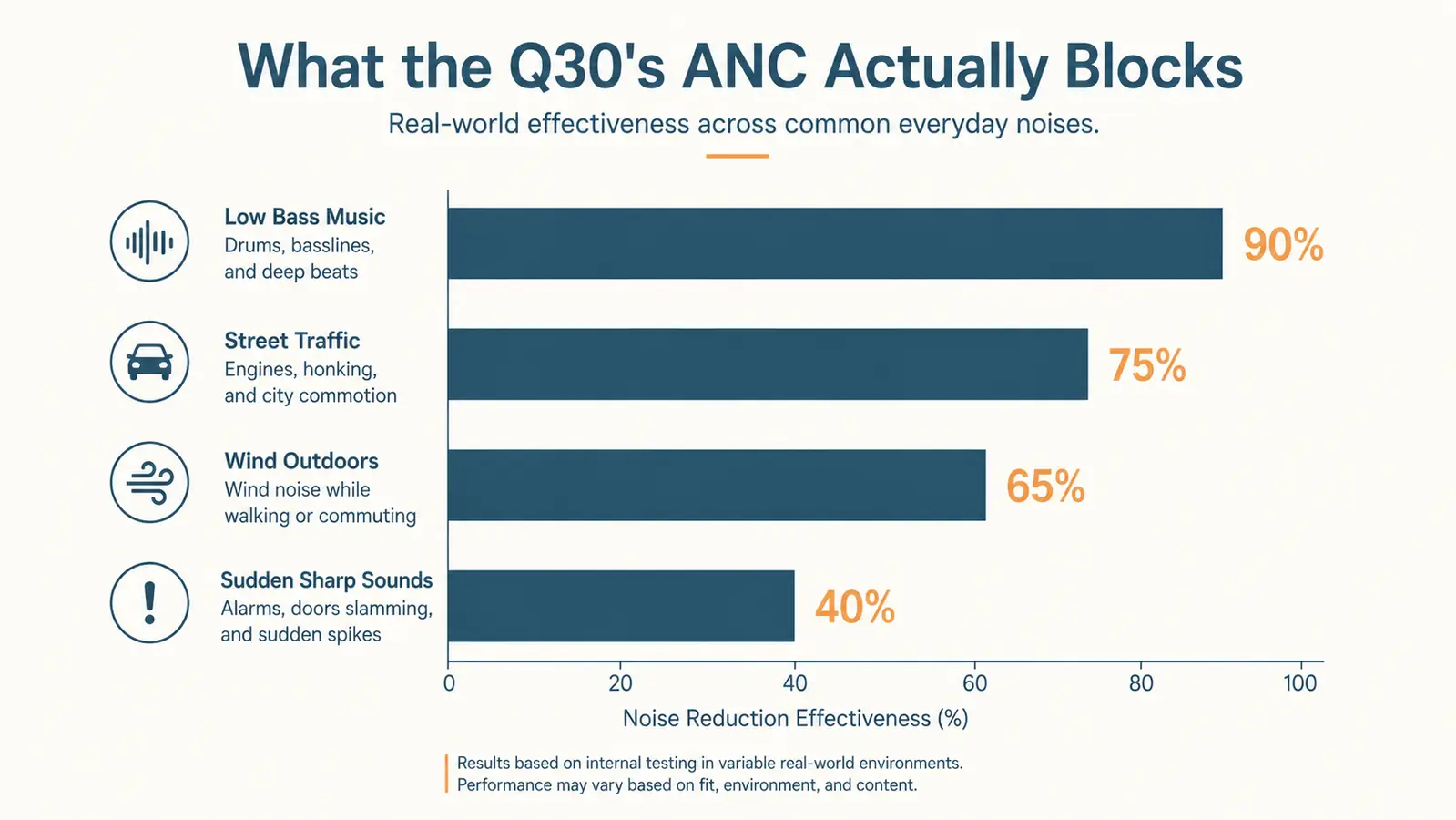
None of this means I regret buying them, and I want to be clear about that because an honest review has to include the parts that work, not just the complaints. Against the bass-heavy playlists bleeding through my apartment wall from the gym next door, the Q30's ANC does something I genuinely didn't expect at this price. It doesn't erase the bass entirely, but it flattens it into something closer to a distant hum I can write through instead of a rhythm my brain keeps trying to track.
The same goes for the bus stop under my window. Idling engine noise, the hiss of doors opening, the low rumble of the diesel engine pulling away, all of it drops to something I have to actively focus on to notice once Indoor mode is switched on. I compared this directly against a coworker's older non-ANC Bluetooth headset in the coworking space one afternoon, and the difference wasn't subtle. He could still hear the espresso machine three tables over. I couldn't.
Multipoint connection has also worked better than I expected for switching between my laptop and phone without manually disconnecting one first. It's not flawless, there's an occasional two or three second lag when a call comes in while I'm mid-focus-session on my laptop, but it beats the manual re-pairing dance I dealt with on a previous budget headset. For the price, getting genuinely strong ANC, workable multipoint, and 38-plus hours of real battery life while accepting a cheap pouch and an overly sensitive touch panel feels like a fair trade, not a hidden catch.
What I Liked
- Hybrid ANC meaningfully reduces bass-heavy noise bleeding through walls and idling traffic noise
- Real-world battery life lands close to the advertised 38 to 40 hours with ANC on
- Multipoint connection switches between laptop and phone with only minor lag
- Custom EQ in the Soundcore app noticeably improves voice clarity for calls
- Strong value relative to premium ANC headphones two to three times the price
Where It Falls Short
- Touch panel on the right ear cup is oversensitive and has no adjustable sensitivity setting
- Transparency mode sounds hollow and picks up wind noise badly outdoors
- Included case is a thin fabric pouch with no cable storage and minimal protection
- No physical buttons, so all controls rely on the touch surface working correctly
- Hi-Res Audio certification only applies over the rarely used wired cable connection
The Q30 isn't trying to be perfect. It's trying to be good enough for less than a third of what the premium brands charge, and on that specific promise, it actually delivers.
Who This Is For
If you live or work somewhere with constant background noise, an apartment near a busy street, a shared wall with a gym or a TV, a coworking space with chatter, the Q30's ANC will earn its price back within the first week just from the stress it removes. Anyone willing to spend a few days learning the touch panel's quirks and buying a case sleeve to actually protect these on the go will end up with a genuinely solid daily driver for calls and focused work.
Who Should Skip It
If you need to frequently interact with people around you while wearing headphones, front desk work, retail, anywhere transparency mode has to actually sound natural, the Q30's hollow ambient audio will bother you more than it bothered me on occasional walks. And if you're rough on gear or transport your headphones loose in a bag daily, budget for a separate hard case, because the included pouch will not protect these the way you'd hope.
The honest version, four months in
I still wear these every day despite the touch panel and the flimsy case. If constant background noise is the real problem you're trying to solve, this is still the pair I'd point you to first.
Amazon Check Today's Price on Amazon →