
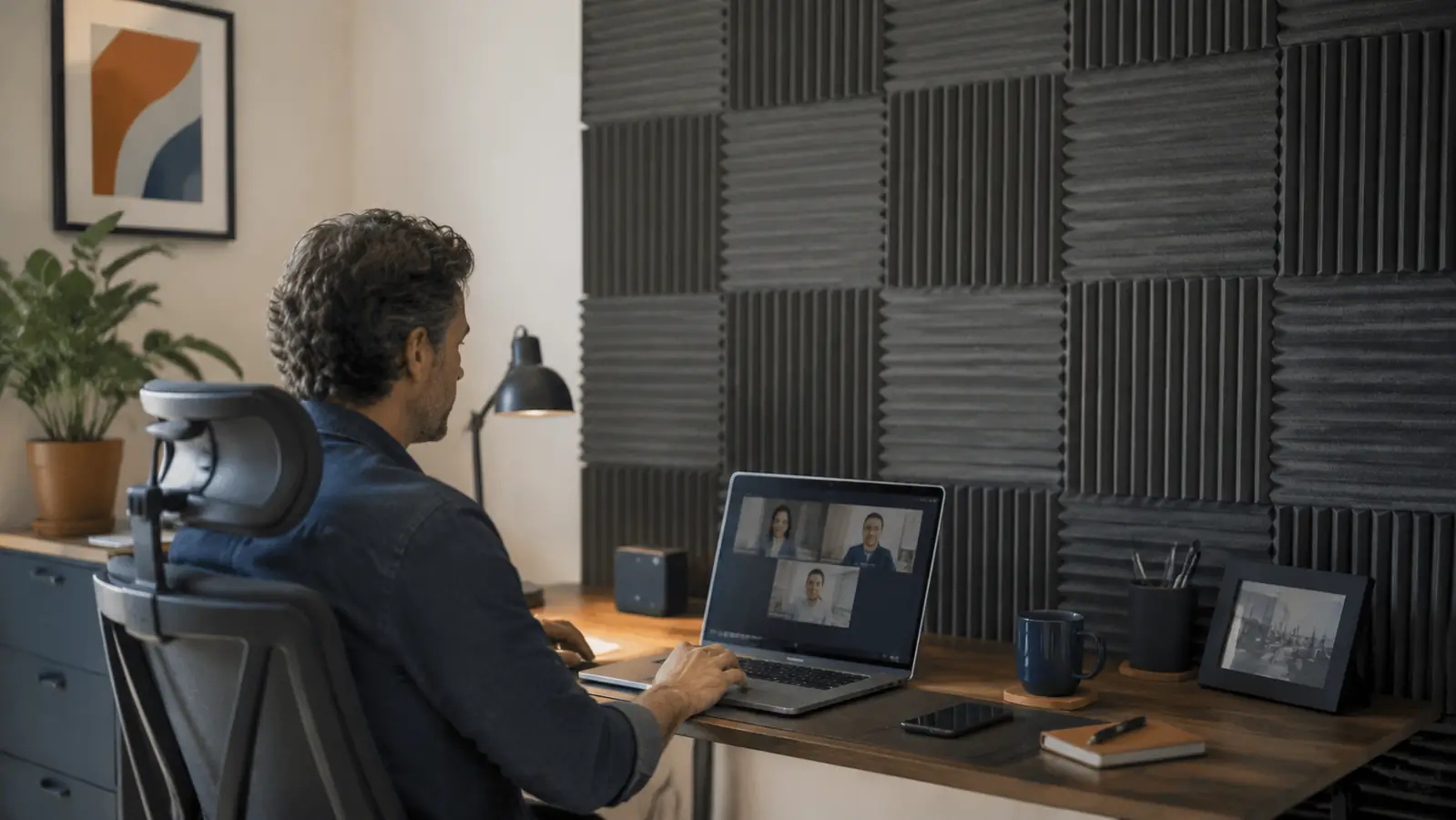
Short answer first, since I know that is why you clicked. If your video calls sound like you are talking inside a bathroom, the JBER Acoustic Foam Panels fix the actual problem. If the issue is a barking dog, a noisy street, or a roommate's TV bleeding through the wall, a white noise machine like the Magicteam handles that better. These two products get compared constantly because they both show up in the same searches for a quieter home office, but they are not solving the same complaint, and buying the wrong one for your specific problem is the most common mistake I see people make in this category.
I set up my own test to separate the two claims instead of guessing. My home office is a spare bedroom with a hard laminate floor, one bare drywall wall behind my desk, and a hollow-core door that does nothing to stop hallway noise. I recorded the same 60-second voice memo before treatment, then again after mounting 12 JBER panels on the wall behind my monitor, then again with a Magicteam white noise machine running at a moderate volume near the door instead of the panels installed. Three different problems, three different results, and only one of them actually came from the room itself.
It is worth being upfront about why this comparison confuses people in the first place. Both products get marketed under the umbrella of a quieter workspace, and both cost less than a premium solution, so shoppers naturally assume they are interchangeable solutions to the same complaint. They are not. One is a passive treatment that changes how sound behaves inside a specific room. The other is an active device that adds a new sound to cover up sounds you do not control. Understanding that split before you spend money is the difference between fixing your actual problem on the first try and buying a second product a month later when the first one does not do what you expected.
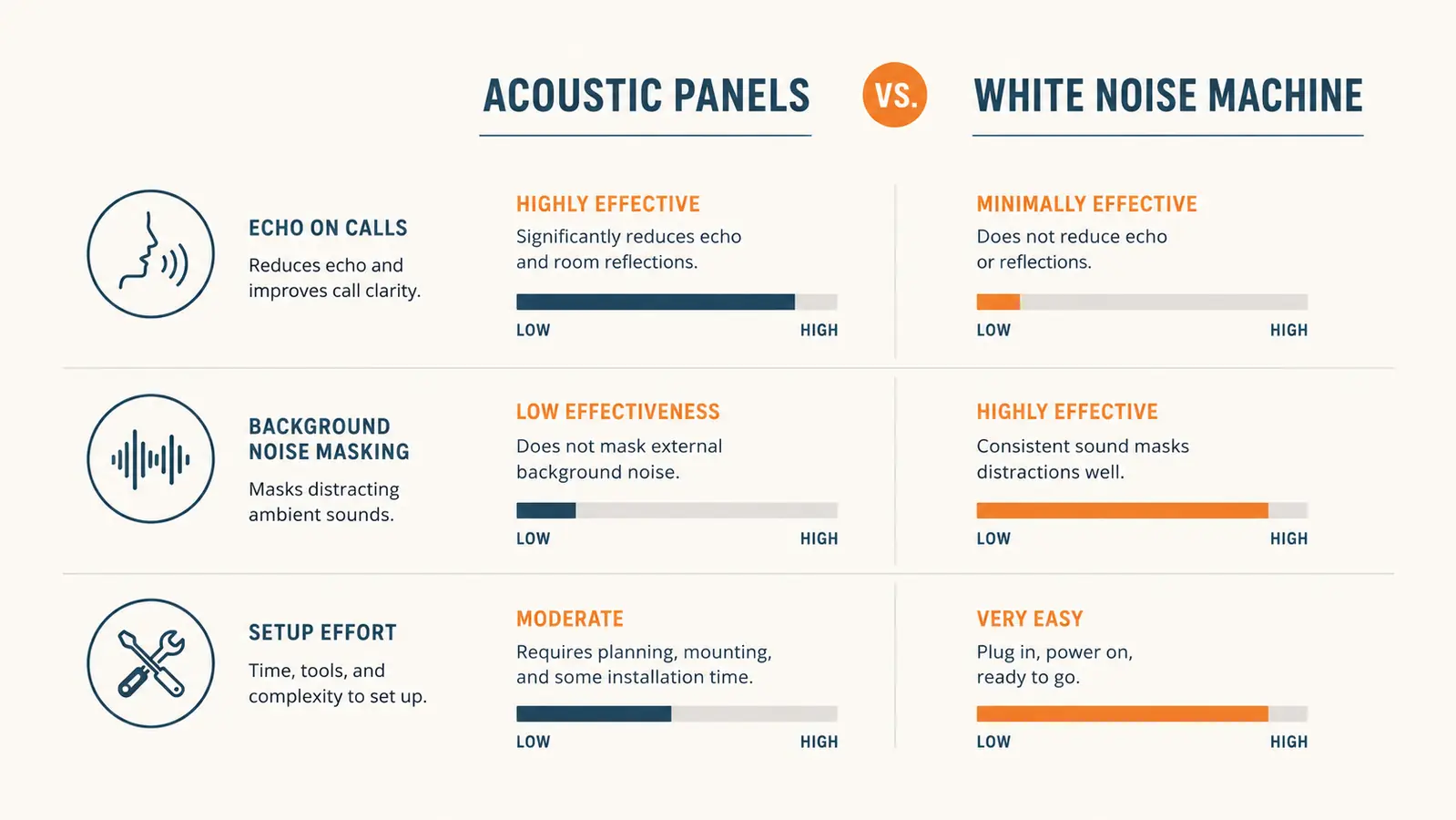
| Acoustic Panels | White Noise Machine | |
|---|---|---|
| Price | Sold as a 12-pack, one-time purchase | Budget-friendly, one-time purchase |
| What It Actually Does | Absorbs sound reflections off hard walls, reduces echo and reverb in the room itself | Generates a steady background sound to cover up outside noise, does not change the room's acoustics |
| Fixes Echo on Video Calls | Yes, directly, since echo comes from sound bouncing off bare walls | No, it can even make echo more noticeable by adding another sound source into a reflective room |
| Blocks Noise From Outside the Room | Minimal, foam absorbs reflections but does not stop sound transmission through walls or doors | Yes, effectively masks street noise, barking dogs, or household chatter |
| Installation Effort | Command strips or included adhesive, roughly 30 to 45 minutes for a full 12-panel wall | Plug in or run on batteries, ready in under a minute |
| Permanence | Semi-permanent, mounted directly to the wall, leaves light adhesive marks if removed | Fully portable, can move it room to room or take it with you |
| Effect on the Room When Off | Works passively at all times, no power needed, still reducing echo when you are not on a call | Only does anything while it is turned on and running |
| Best For | Rooms with hard, bare walls and noticeable echo or hollow sound on recordings and calls | Rooms with echo already under control but noise bleeding in from outside the room |
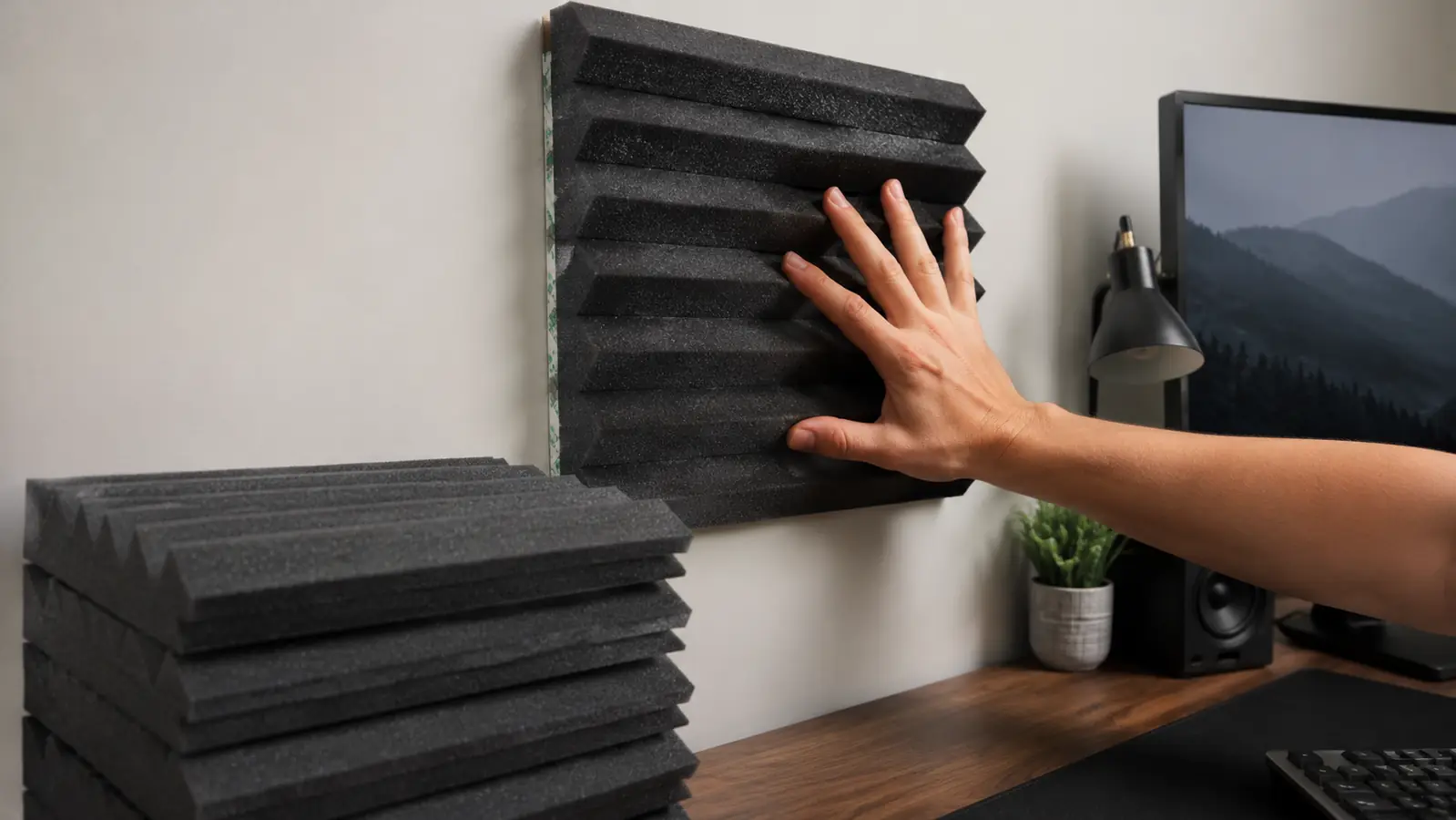
Where the JBER Acoustic Panels Win
The difference showed up immediately in my recordings. Before treatment, my voice memo had a noticeable slap-back echo, the kind where words sound like they are bouncing off something a half second after you say them. That is what a bare drywall wall does to sound, and it is the exact complaint I hear most from people who say their coworkers keep asking them to repeat themselves on Zoom. After mounting the 12 JBER panels directly behind and to the side of my desk, that same recording came back noticeably flatter and closer sounding, like I had moved from a small empty room into a room with furniture and curtains in it. That is not a subtle difference. It is the kind of thing a client notices in the first ten seconds of a call without knowing why.
The panels also work whether or not you remember to turn anything on, which matters more than it sounds like it should. I have forgotten to switch on a white noise machine plenty of times before an important call. The foam panels do not have that failure mode. They are 1 inch thick, high density, and the wedge cut pattern that looks decorative is actually doing real work breaking up sound reflections instead of letting them bounce straight back at the microphone. Mounting took me about 40 minutes for the full wall using the adhesive squares that come in the box, no drilling, and the panels are light enough that nothing has sagged or peeled off in the four months since I put them up.
There is also a fire-resistance rating on these panels that I did not think much about until a friend asked whether foam on a wall was a safety concern with a desk lamp nearby. It is rated fire resistant, which is not something every cheap foam panel on Amazon can claim, and it is worth checking for on any brand you consider if you plan to mount panels near cords or lighting. Beyond that, the panels have held their gray color without yellowing near my window, which two other rooms in my house get direct afternoon sun through, so I was watching for that specifically.
Where the Magicteam White Noise Machine Wins
I do not want to make the panels sound like a universal fix, because they solved my echo problem and did nothing at all for the noise coming through my office door from the rest of the house. My dog barking at the mail carrier, my kid's tablet playing cartoons two rooms away, a neighbor mowing on a Tuesday afternoon, none of that changed with foam on the wall. Acoustic panels absorb reflections inside a room, they do not stop sound from traveling through a door or a shared wall. That is physics, not a shortcoming of this specific product, and it applies to acoustic foam in general, no matter which brand's panels you buy or how many you mount.
That is exactly the gap a white noise machine like the Magicteam fills. Running it near my office door at a moderate volume covered the hallway noise enough that it stopped registering on my test recordings at all. It has 20 non-looping natural sounds and 32 volume levels, which sounds like overkill until you realize the right sound at the right volume genuinely does mask specific problem noises better than a generic hum does. It also runs on USB power, so it sits quietly on a shelf and needs zero installation, which is the opposite experience of mounting a wall's worth of foam. If your actual problem is noise coming from outside your room rather than your own voice bouncing around inside it, this is the tool built for that job, and the panels simply are not.
The portability is worth mentioning too, since it is the one category where the machine clearly beats the panels. I can pick up the Magicteam unit and carry it to a hotel room during a work trip, or move it to a different corner of the house entirely if my noise problem shifts with the seasons. The panels, by contrast, stay wherever you mount them. If you rent your home office space or move apartments often, that difference alone might tip the decision toward the machine even if your bigger issue is technically echo, simply because you cannot take a mounted wall of foam with you when the lease is up.
If your team keeps asking you to repeat yourself on calls, your room is the problem, not your microphone.
The JBER Acoustic Foam Panels tackle echo at the source, working around the clock with no power switch to forget. See today's price and get a quieter-sounding office without touching your headset settings.
Amazon Check Today's Price on Amazon →
Who Should Buy Which
If you have ever been told your voice sounds hollow, distant, or like you are in a stairwell, buy the acoustic panels first. That is a room problem, and no amount of masking sound will change how your own voice reflects off a bare wall behind your desk. I would start with the wall directly behind your head, since that is the surface closest to your microphone and doing the most damage to your sound. A 12-pack covers a modest wall section, roughly what you need for a single desk setup, and you can always add a second pack later if the echo is coming from more than one direction.
If your calls already sound clear but you are dealing with noise that is not coming from you, a white noise machine is the better first purchase. That covers barking dogs, street traffic, a noisy HVAC system, or a partner on their own call in the next room. It will not fix echo, and running it in a room with bad acoustics can actually add another layer of noise to an already reflective space, so know which problem you actually have before you spend money on either one.
The two are not mutually exclusive, and plenty of home offices genuinely need both. My own setup now runs the JBER panels on the wall behind my desk permanently, with the Magicteam machine near the door that I switch on only when the house gets loud during work hours. That combination was budget-friendly and solved two separate problems that no single product was ever going to fix on its own. If you can only afford one right now, though, start with whichever complaint you actually hear back from other people, either that your voice sounds echoey, or that they can hear noise you did not even notice yourself.
One last practical note before you decide. Record yourself for 30 seconds on your phone right now, in your actual office, and play it back. If it sounds thin, hollow, or like you are in an empty room, that is echo, and panels are your answer. If your own voice sounds fine but you can hear a dog, a TV, or traffic in the background, that is a masking problem, and the white noise machine is the one built for it. That one test settles the decision faster than any spec sheet, mine included.
A quieter-sounding call starts with the wall behind you, not a new microphone.
The JBER Acoustic Foam Panels install in under an hour and keep working every single call after that, no batteries and nothing to switch on. Check the current price on Amazon before your next big meeting.
Amazon Check Today's Price on Amazon →